
Instructional Design in Abstraction
As part of the EDIT 451: Survey of Instructional Design, students were asked to generate learning artifacts. Following are two learning artifacts constructed during the 10-week course.
Click on the or
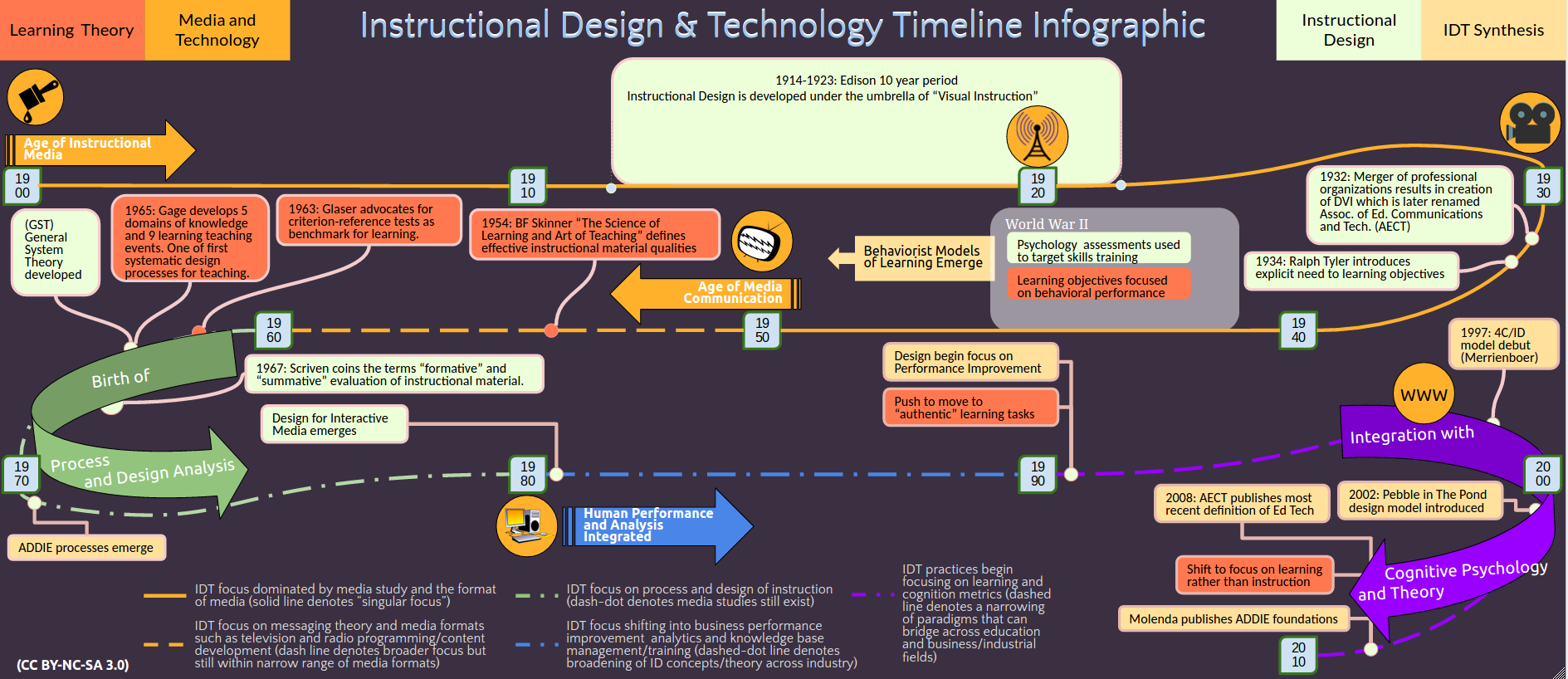
Instructional Design History Timeline
Based on reading from Reiser, R. (2012). Trends and issues in instructional design and technology (3rd ed., pp. 1-27). Boston: Pearson. students were asked to construct an infographic timeline about the history of instructional design and technology.
Key Learnings
- The term educational technology, educational media, and technology media have been fluid and used interchangeably at times.
- Google Draw does not always preserve text in a "what you see is what you get" fashion.
Artifact
Media Video: Learning Objects
Working in pairs, students were asked to deliver a media component delivering information about a particular chapter from the Reiser textbook. In this artifact, Chapter 30 served as the content material for the media video.
Key Learnings
- Audio recording is easy to capture and edit with Audacity
- Room acoustics cannot be completely mitigated in editing
- Listen to recordings for quality before recording an entire project
- Flash syncing is not guaranteed (use a separate program to listen to audio for timing and sync animations in flash using time references instead of timeline position)
Artifact
This video can be viewed in SWF format (for better graphic viewing) or MP4 format (for non-flash enabled devices).
We are drowning in information, while starving for wisdom. The world henceforth will be run by synthesizers, people able to put together the right information at the right time, think critically about it, and make important choices wisely.